

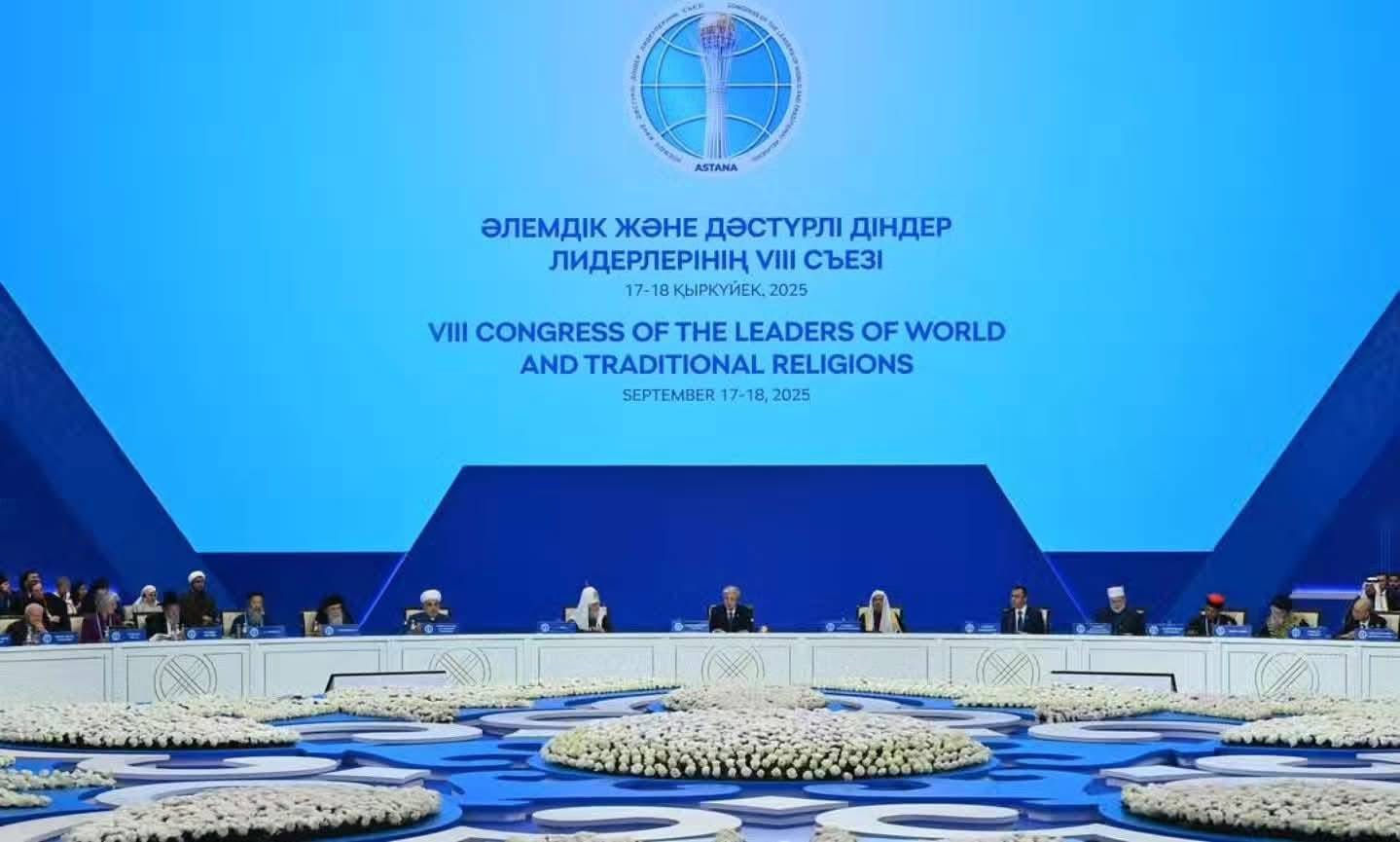
Kazakhstan: VIII Congress of Leaders of World and Traditional Religions
Historical milestones of the past week...
Spiritual diplomacy, Kazakhstan's initiatives for the final resolution, and the promotion of the enduring UN principle of "Unity in Diversity"...
Offline participation on the sidelines of the VIII Congress of World and Traditional Religions further underscored the significance of its format and perception.
The special attention of Kazakhstan's President Kassym-Jomart Tokayev to the Congress and its participants, and the expansion of its general humanitarian mission—to more actively utilize the rich spiritual heritage of world religions and shared historical experience to address global challenges facing humanity in the new geopolitical environment—gave impetus for more detailed scientific and expert research.
—The important role of spiritual diplomacy in strengthening dialogue and trust in the international arena, in the context of moral guidelines and humanistic values.
—The final declaration of the Congress, ensuring the development of constructive dialogue and a willingness to unite in the name of common interests. According to the President of Kazakhstan, "true wisdom is demonstrated precisely in the ability to conduct constructive and meaningful dialogue."
Particular attention was paid to issues of ecology, sustainable development, and the impact of new technologies and artificial intelligence on people's lives, all of which were supported by Kazakhstan's initiatives. - Many valuable ideas and proposals were expressed, including from young religious leaders...
- Meetings and opportunities for discussion with the expert community, including international ones, and the presentations made at the plenary session and breakout sessions provided food for thought for a detailed study of the congress materials and its history, including the materials of the special session "In Partnership with the UN Alliance of Civilizations" for future enopolitical scientists and diplomats.
The Academy of the Assembly of Peoples of Kazakhstan (APK) – new tracks in the training of journalists' club leaders and ethnic media editors... at the scientific, educational, and public platform of the L.N. Gumilyov Eurasian National University. This support is invaluable.
- Training of representatives of the Assembly of Peoples of Kazakhstan (APK) public institutions at the ENU is already the fourth popular project, each original and specifically addressed to a specific target audience: directors of Friendship Houses, leaders of ethnocultural associations, leaders of the Assembly of Peoples of Kazakhstan mothers' councils, journalists' clubs, and ethnic media editors. All projects were implemented with the support of the Assembly of Peoples of Kazakhstan and the parliament's deputy corps. Kazakhstan, government agencies, leading experts, scientists, doctoral and master's students of the APK Department.
- 4-5-day intensive courses and immersive learning experiences, participation in focus group discussions on relevant topics, trainings, and seminars provide the opportunity to continue work in the regions, which has already begun with the support of the APK Department...
This socio-humanitarian educational modular project – the APK Academy – has been successful, is in demand, and requires further development.
The meeting with the OSCE High Commissioner on National Minorities, Christoph Kamp, took place in the format of an expert discussion and public lecture at Nazarbayev University with the participation of faculty, doctoral and master's students of the APK Department.
Christoph Kamp is brilliantly knowledgeable about the state and development of interethnic relations and the role of the APK in this process, and therefore the expert discussion focused on cooperation to reduce interethnic tensions and prevent conflicts through dialogue, consultation, and practical recommendations. Here, expert opinions are more important than ever, and the High Commissioner expressed interest in the research conducted by Kazakhstani scientists and innovative researchers. ENU's programs for training ethnopolitical scientists and diplomats.
The public lecture showcased the history of the Institute and the Office of the High Commissioner, as well as the speaker's (Christoph Kamp) engaging grasp of the material and intuition for the audience. This was confirmed by open, sometimes challenging, questions and answers.
The focus has been set on cooperation with Kazakhstan and further study of the experience of preserving national unity amid ethnic and religious diversity. For our master's and doctoral students studying ethnopolitical processes and national models in the modern world, this is a case study for further study and scientific diplomacy.
The Department of ANC at L.N. Gumilyov ENU wishes all who support us and believe in the potential of our master's and doctoral students a warm welcome!
Polina Nerush